
PART 6 — MY DAUGHTER TRIED TO SELL HER SON’S INHERITANCE, BUT SHE DIDN’T KNOW WHAT HIS GRANDFATHER HAD HIDDEN
For a long moment, nobody spoke.
Mitchell sat behind the wheel of his rattling pickup truck, staring at the telephone as though it had suddenly become something dangerous.
I could hear Jillian crying on the other end.
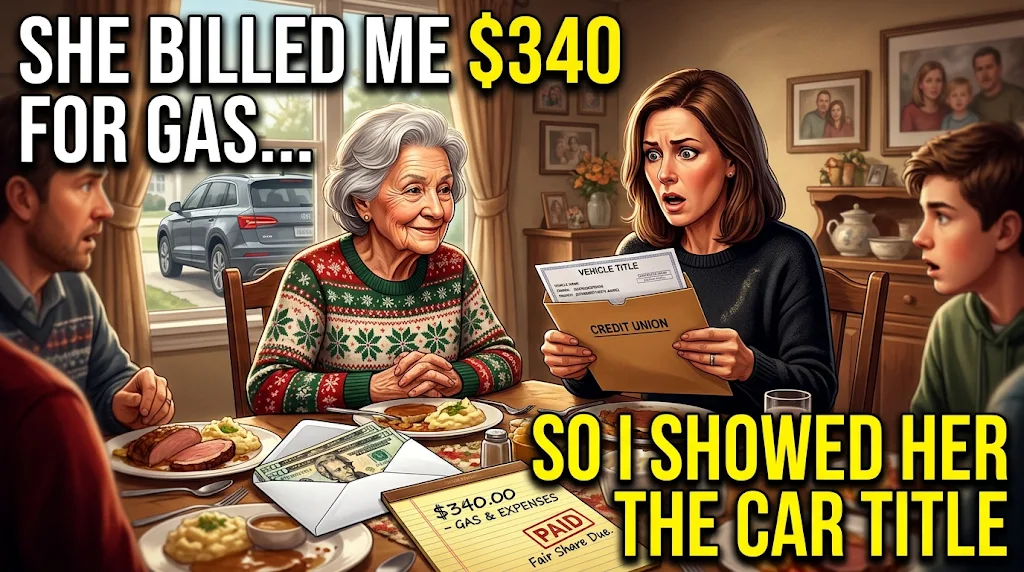
And I sat beside my grandson, trying to understand how my daughter had managed to turn a three-hundred-and-forty-dollar bill into a nightmare involving forged signatures, secret loans, a missing will, and forty acres of land.
“Jillian,” I said quietly, “tell me exactly what you signed.”
She sniffled.
“Mama, I didn’t think it would go this far.”
“What did you sign?”
“A purchase agreement.”
“For land that isn’t yours?”
“I thought I could straighten out the ownership before closing.”
Mitchell suddenly leaned forward.
“Mom, that’s Grandpa’s land?”
She went silent.
“Mom?”
“Yes.”
“And Grandpa left it to me?”
Another silence.
“That’s what the paper says.”
I watched my grandson’s face.
He was twenty years old.
He’d spent his childhood listening to Harold talk about tractors, fence posts, and the little creek that ran behind his brother’s old farm.
He’d never known that a piece of that land might one day belong to him.
“Why didn’t you tell me?” he asked.
Jillian started crying harder.
“Mitchell, honey, I was going to give you some of the money.”
He stared at the dashboard.
“Some?”
“Yes.”
“How much?”
She hesitated.
“Enough to help with school.”
Mitchell closed his eyes.
“Mom, you were going to sell something Grandpa left me, and then decide how much of it I deserved?”
“That isn’t fair!”
His voice shook.
“What’s not fair?”
“I raised you! I worked hard to give you everything!”
I reached over and gently touched Mitchell’s arm.
He took a breath.
Then he said something that made my heart ache.
“Mom, I never asked you for that land. I didn’t even know it existed.”
She was silent.
“But if Grandpa wanted me to have it, why would you keep that from me?”
“Because I needed help!”
Those words came out like a scream.
I closed my eyes.
There it was again.
The same explanation for everything.
She needed help.
So she’d used my name.
She’d hidden the insurance money.
She’d tried to control the SUV.
And now she’d signed an agreement involving land her father might have intended for her son.
I spoke softly.
“Jillian, who is buying the land?”
She hesitated.
“A company.”
“What company?”
“Prairie Ridge Development.”
I looked at Mitchell.
He frowned.
“Grandma, I’ve heard that name.”
“Where?”
“They’ve been trying to buy property outside town for a commercial project.”
I turned toward the telephone.
“Jillian, when is the closing?”
She began crying again.
“Mama…”
“When?”
“Friday.”
I felt a chill.
It was Tuesday.
Three days.
“Jillian, you’re going to send copies of everything you signed to Margaret Ellis.”
“No!”
“Then I’ll tell her what you’ve told me and let her find out through the proper records.”
“Mama, they’ll sue me!”
I took a slow breath.
“That is why you need your own lawyer.”
She whispered, “I can’t afford one.”
I stared through the windshield at the small houses lining our street.
For years, that sentence had been enough to make me reach for my checkbook.
But this time, I didn’t.
“Jillian, I can’t solve this for you.”
She began sobbing.
“Mama, please.”
“I love you, honey. But I won’t help you take something that may belong to Mitchell.”
Then I ended the call.
Mitchell sat silently.
His hands were gripping the steering wheel so tightly that his knuckles had turned white.
Finally, he whispered, “Grandma, I don’t even know what to think.”
I looked at him.
“Neither do I, sweetheart.”
He swallowed.
“Do you think Grandpa really left me that land?”
“I don’t know yet.”
“But Mom said—”
“I know what she said. And tomorrow we’re going to find out what the records say.”
He nodded slowly.
Then his eyes filled.
“Grandpa used to take me fishing out there.”
I remembered.
Harold would pack sandwiches in wax paper and bring Mitchell home smelling like creek water and sunshine.
They’d come through my kitchen door laughing, their boots covered in mud.
Harold always said the boy had patience.
“That child can sit beside a fishing hole for three hours without complaining,” he’d tell me. “He’s got the soul of a farmer.”
I smiled sadly.
“Your grandfather loved that place.”
Mitchell wiped his eyes.
“I thought his brother sold it.”
“So did I.”
We sat there another moment.
Then Mitchell started the truck.
“Come on, Grandma. Let’s get you inside.”
That evening, I called Margaret Ellis.
I told her everything.
The missing page.
The forty acres.
The purchase agreement.
The Friday closing.
She listened without interrupting.
Then her voice became very firm.
“Edith, do you have any copy of the missing page?”
“No.”
“Did Jillian say she has the original?”
“She said she still has it.”
“All right. First, we need to verify the estate records and the current ownership of that property. A missing page doesn’t automatically establish who owns the land.”
I nodded, though she couldn’t see me.
“Can somebody sell it without Mitchell’s permission?”
“That depends on who legally owns it and what authority the seller actually has. A signed purchase agreement doesn’t necessarily mean the property can be transferred.”
I exhaled.
“What should we do?”
“I’ll begin reviewing the recorded documents and the probate file. Given the proposed closing date, I’ll also contact the appropriate parties as soon as we have enough information.”
I looked toward Harold’s photograph.
“Margaret, I don’t want my grandson to lose something his grandfather wanted him to have.”
“I understand.”
She paused.
“But I need you to promise me something.”
“What?”
“Don’t confront the buyer yourself, and don’t sign anything Jillian brings you.”
I almost laughed.
“Believe me, I’ve learned that lesson.”
After we hung up, I made myself some tea.
Then I walked into my bedroom and opened the bottom drawer of Harold’s old dresser.
His clothes were still there.
Not all of them.
Just a few things I hadn’t been able to part with.
A blue work shirt.
A brown sweater.
His old fishing hat.
I lifted the hat and held it against my chest.
“Oh, Harold,” I whispered, “what have we gotten ourselves into?”
I sat on the bed.
Then I noticed something tucked into the hatband.
A small folded card.
I’d seen it before, years ago, but I’d never paid much attention.
It was a business card from an attorney named Thomas Whitcomb.
Harold had known him through the American Legion.
On the back, in Harold’s handwriting, were four words.
Ask Tom about Mitchell.
My heart began pounding.
I stared at the card.
Mitchell.
Why would Harold have written his grandson’s name on an attorney’s business card?
I searched my memory.
Thomas Whitcomb had attended Harold’s funeral.
He’d shaken my hand and told me Harold was a good man.
But I couldn’t remember speaking to him afterward.
I placed the card beside the telephone.
Then I called Mitchell.
“Sweetheart, do you remember Mr. Whitcomb?”
He thought for a moment.
“Grandpa’s lawyer?”
“Possibly.”
“Why?”
“I found something.”
I read him the words on the card.
There was a pause.
“Grandma, that’s weird.”
“It certainly is.”
“Do you want me to look him up?”
“Please.”
Ten minutes later, Mitchell called back.
“Grandma, Mr. Whitcomb retired a few years ago.”
My heart sank.
“But his old firm is still open.”
I sat upright.
“Can you give me the number?”
He did.
I wrote it in my notebook.
Then I went to bed with Harold’s business card beneath my pillow.
I know that sounds foolish.
But sometimes, when you’ve been married to somebody for nearly forty years, you hold on to whatever little piece of them you can find.
The next morning, Mitchell arrived early.
We called Margaret first and told her about the business card.
She suggested letting her contact the firm as part of reviewing Harold’s estate.
By eleven o’clock, she called us back.
“Edith, I’ve spoken with someone who remembers Harold.”
My heart began pounding.
“Who?”
“Thomas Whitcomb’s former assistant. Her name is Eleanor Pierce.”
I sat down.
“Does she remember my husband?”
“Very well.”
“Did Harold leave something with that office?”
Margaret paused.
“Edith, she said there may be an archived file relating to a trust.”
I stared at Mitchell.
“A trust?”
“Yes.”
“What kind of trust?”
“We don’t know yet. The firm is retrieving the archived records.”
I pressed my hand against my chest.
“Margaret, Harold never told me about a trust.”
“That’s why we need to see the documents before drawing conclusions.”
I nodded.
She continued.
“There’s another detail.”
“What?”
“The assistant remembered your husband specifically discussing his grandson.”
I looked toward Mitchell.
He was watching me with wide eyes.
“Did she say what about him?”
“Only that Harold wanted certain property protected for Mitchell’s future.”
I couldn’t speak.
Harold.
My quiet, careful husband.
The man who counted coupons and repaired our toaster instead of buying a new one.
Had he arranged something all those years ago because he knew his daughter struggled with money?
I whispered, “He always worried about them.”
Margaret’s voice softened.
“Perhaps the records will tell us more.”
That afternoon, we went to the county recorder’s office.
Margaret had arranged for us to review the relevant property records with assistance.
I brought my identification and the papers she requested.
Mitchell carried the folders.
A clerk helped us locate the recorded documents associated with Harold’s old farmland.
And there it was.
Forty acres.
The same parcel my daughter claimed she had agreed to sell.
But the records didn’t show Jillian as the owner.
They showed a trust.
The Harold J. Lawson Family Trust.
I stared at the enlarged printout.
“Margaret,” I whispered, “what does that mean?”
She pointed to the recorded information.
“It means the property was conveyed into a trust years ago. We still need the trust instrument to determine who has authority over it and who benefits from it.”
Mitchell leaned closer.
“Does that mean Mom can’t sell it?”
“Not in her personal capacity merely because she’s Harold’s daughter,” Margaret answered. “But we need to verify every relevant document.”
I felt my shoulders loosen for the first time in days.
Not because the problem was solved.
It wasn’t.
But because a record existed that Jillian apparently hadn’t known how to explain away.
Margaret examined another page.
Then she stopped.
“Edith, this is interesting.”
“What?”
“The trust transfer was recorded shortly before Harold died.”
I looked at her.
“How shortly?”
“About four months.”
My eyes filled.
Four months before Harold died.
He’d been weak by then.
Tired.
But still insisting on walking to the mailbox every afternoon.
I remembered him sitting at the kitchen table one evening, writing in a yellow legal pad.
When I’d asked what he was doing, he’d smiled.
“Just making sure things are in order, Edie.”
I’d assumed he meant the household bills.
Now I wondered if he’d been making plans I had never understood.
Margaret folded the printout.
“We have more work to do.”
I nodded.
Then she said, “There is something else I need to tell you.”
I looked up.
“The developer’s attorney contacted my office.”
My stomach tightened.
“Why?”
“Because I notified the company that a proposed sale might involve disputed authority and that we were reviewing the ownership records.”
“What did they say?”
“They said they’ve already paid a deposit under the agreement.”
Mitchell stared at her.
“How much?”
Margaret checked her notes.
“Twenty-five thousand dollars.”
I felt sick.
“To whom?”
“According to what they told me, the funds were delivered to an account designated in Jillian’s agreement. We’re requesting documentation.”
I put a hand over my mouth.
Twenty-five thousand dollars.
Had my daughter already taken it?
Had she spent it?
Was that why she was so desperate?
Margaret continued.
“Edith, it’s important that you understand something. The developer may have its own legal remedies under that agreement, and Jillian needs independent counsel immediately.”
I nodded slowly.
Then I asked the question that frightened me most.
“If the company demands its money back and she doesn’t have it, what happens?”
Margaret looked at me kindly.
“That depends on the agreement and the facts. I can’t predict the outcome.”
I looked toward Mitchell.
He had gone very quiet.
“Grandma,” he whispered, “Mom is in real trouble.”
I closed my eyes.
“I know, sweetheart.”
We drove home in silence.
That evening, Daniel came to my house alone.
He looked exhausted.
His eyes were red.
His shirt was wrinkled.
He sat at my kitchen table without touching the coffee I’d made him.
“Edith, I don’t know who my wife is anymore.”
I felt a terrible sadness.
“Daniel…”
He shook his head.
“She told me she’d received some inheritance money years ago. She said it was gone before we married.”
I nodded.
“That’s true.”
“But she never told me about the farmland.”
I said nothing.
“And now there are people calling the house.”
My stomach tightened.
“What people?”
“The development company. A lender. Somebody asking about documents.”
He rubbed his forehead.
“Jillian won’t tell me everything.”
I looked at him.
“Daniel, have you spoken to a lawyer?”
“Not yet.”
“You need to.”
He nodded.
Then he reached into his coat pocket.
“I found something.”
He placed a small envelope on the table.
It was addressed to Jillian.
The handwriting wasn’t hers.
Nor was it Harold’s.
I looked at Daniel.
“What is this?”
“It was in her desk drawer. It had already been opened.”
“Then why are you bringing it to me?”
“Because I think it might help explain what she’s hiding.”
He slid a photocopy of a letter from the envelope.
It was dated six months earlier.
The heading read:
NOTICE OF PROPOSED PURCHASE — PRAIRIE RIDGE DEVELOPMENT.
Mitchell, who’d been sitting nearby, leaned forward.
Daniel pointed to a paragraph.
“The company had been trying to contact the trustee.”
I frowned.
“Which trustee?”
He looked at me.
“That’s the part I don’t understand.”
He showed us the final page.
There was a name printed beneath a line marked Trustee Contact.
Not Jillian.
Not Daniel.
Not Mitchell.
My name.
Edith Margaret Lawson.
I stared at it.
“Daniel, I have never been contacted about selling that land.”
He nodded.
“That’s what I thought.”
I looked at the letter again.
Then I noticed a handwritten note in the margin.
Someone had written:
Mother must not receive this.
The handwriting was Jillian’s.
I knew it.
I had been reading her handwriting since she was in kindergarten.
Mitchell leaned back.
“She knew Grandma was supposed to be contacted.”
I felt my chest tighten.
Margaret had told us not to draw conclusions before reviewing the trust.
But the note made one thing painfully clear.
My daughter had deliberately kept this letter from me.
Daniel lowered his head.
“I don’t know what to do.”
I reached across the table.
“Daniel, you cannot make Jillian tell the truth.”
He looked at me.
“But you can decide what you’re willing to believe without evidence.”
He nodded slowly.
Before he left, he promised to give the letter to Margaret and to seek his own legal advice.
Afterward, Mitchell helped me put away the dishes.
Then he turned toward me.
“Grandma, do you think Grandpa knew Mom might do something like this?”
I thought about Harold.
His quiet nature.
His careful habits.
The way he’d always insisted on keeping important papers in more than one place.
“I think your grandfather knew that loving someone and trusting them with money aren’t always the same thing.”
Mitchell nodded.
Then he asked, “Do you think he really wanted me to have the farm?”
I smiled sadly.
“I think he wanted you to have a future.”
My grandson looked down.
“Even if it turns out I don’t own it, I wish I could tell him thank you.”
My eyes filled.
“Oh, sweetheart. I think he knew.”
The next morning, Margaret called at eight-thirty.
Her voice sounded different.
Not frightened.
Not uncertain.
Excited.
“Edith, the archived documents arrived.”
I sat straight up.
“From Mr. Whitcomb’s office?”
“Yes.”
“Did you find the trust?”
“We did.”
My hand began trembling.
“And?”
“Edith, I think you and Mitchell need to come to my office.”
My heart sank.
“Is something wrong?”
“No. But there is a provision in this document that neither of you knows about.”
I gripped the telephone.
“What provision?”
She paused.
“Harold left instructions concerning the farmland, his grandson, and the person who would manage the trust after his death.”
I looked toward the photograph on my wall.
“What instructions?”
Margaret took a breath.
“Edith, according to the trust instrument, you were named as the original successor trustee.”
For a moment, I couldn’t speak.
“Me?”
“Yes.”
“But nobody ever told me.”
“That’s one of the things we need to investigate.”
I closed my eyes.
“Then who has been managing the land?”
“That is precisely what concerns me.”
A chill ran down my back.
Margaret continued.
“The archived file includes copies of correspondence sent after Harold’s death. At least one letter was addressed to you.”
I sat perfectly still.
“I never received any letter.”
“I understand.”
Then she said something that made my heart begin pounding.
“Edith, the file also contains an acknowledgment stating that you declined to serve as trustee.”
I stared at the wall.
“What?”
“It’s dated eleven years ago.”
My voice shook.
“Margaret, I never declined anything.”
She paused.
“I was afraid you might say that.”
I gripped the edge of the table.
“Whose signature is on it?”
There was a long silence.
Then Margaret answered.
“Yours.”
My knees felt weak.
Another document.
Another signature.
Another decision supposedly made by me without my knowledge.
I whispered, “And who became trustee after that?”
Margaret took a breath.
“Jillian.”
I closed my eyes.
My own daughter.
The person who’d hidden the insurance policy.
The person who’d tried to get me to sign over the SUV.
The person who’d admitted taking out a loan using my information.
Had apparently been managing Harold’s land for eleven years.
But Margaret wasn’t finished.
“Edith, there’s something else.”
“What?”
“Your husband included a personal letter in the trust file.”
My throat tightened.
“A letter?”
“Yes. Addressed to you.”
I pressed my hand against my chest.
“Can you read it?”
“I’d rather you see the original copy when you arrive.”
“Margaret, please. Just tell me what it says.”
She hesitated.
Then she read the first sentence.
“My dearest Edie, if anyone ever makes you feel that helping this family has become your obligation instead of your choice, I want you to remember what we promised each other.”
Tears filled my eyes.
I remembered that promise.
Harold and I had made it on our twenty-fifth wedding anniversary.
We’d been sitting on the porch, watching the sunset.
He’d held my hand and said, “Edie, we’re going to help our children stand on their feet, but we’re not going to let them stand on our backs.”
I’d laughed.
He hadn’t.
Now, eleven years after his death, those words were coming back to me.
Margaret continued.
“Edith, the letter also explains why Harold created the trust.”
I could barely speak.
“Why?”
She paused.
“Because he was afraid someone in the family might try to spend Mitchell’s inheritance before Mitchell was old enough to protect it.”
I felt a coldness settle in my chest.
“Did he name that person?”
Margaret was silent for a moment.
Then she whispered, “Yes, Edith. He did.”
I closed my eyes.
And somehow, before she said another word, I already knew.
It was my daughter.
But what Margaret told me next was something I never could have imagined.
“Edith, Harold didn’t just leave Mitchell forty acres.”
I sat up.
“What do you mean?”
“The trust contains a second asset.”
My heart began pounding.
“What second asset?”
Margaret took a slow breath.
“A separate investment account that was established for Mitchell when he was a baby.”
I stared at the telephone.
“How much?”
She hesitated.
“We’re still verifying the current balance.”
“Margaret, please.”
Her voice became very quiet.
“The last statement in the archived file showed a balance of more than three hundred thousand dollars.”
I couldn’t breathe.
Three hundred thousand dollars.
A secret trust.
A missing acknowledgment.
And a grandson who had been working weekends to pay for his education.
Then Margaret spoke again.
“And Edith, there’s one more thing you need to know.”
I gripped the phone.
“What?”
“The investment account was supposed to be protected until Mitchell reached twenty-five.”
I looked toward the kitchen door.
Mitchell was only twenty.
“Then the money should still be there.”
Margaret didn’t answer immediately.
And in that silence, I felt the fear return.
Finally, she whispered, “Edith, we’re requesting the current records because the archived file contains a later withdrawal authorization.”
My stomach dropped.
“A withdrawal?”
“Yes.”
“Signed by whom?”
She took a breath.
“Jillian, acting as trustee.”
I closed my eyes.
“How much did she withdraw?”
Margaret’s voice trembled slightly.
“Two hundred and seventy-five thousand dollars.”
For a moment, I could hear nothing.
Not the clock.
Not Biscuit scratching at the door.
Not even my own breathing.
Then Margaret added one final sentence.
“Edith, the withdrawal was made three years ago.”
Three years.
The same year my daughter came crying to me because she couldn’t afford a car.
The same year I bought her the gray SUV.
The same year I began paying four hundred and twelve dollars every month out of my pension.
I sank into my kitchen chair.
Because I was beginning to understand something far worse than the disappearance of money.
My daughter hadn’t simply been desperate.
She’d been keeping secrets about how much money she’d controlled.
And now I needed to find out what she’d done with all of it.
END OF PART 6 — TO BE CONTINUED…
You may also like

PART >> 6 My Husband Threw Me Out While I Was in Labor—Then a Three-Star General Saluted Me and Revealed Who I Really Was.
Chapter 14: The Woman Who Had Been Lying to Herself…
PART 6 — THE LAWYER WHO KNEW MY FATHER’S DEADLIEST SECRET
“There’s a reason your father chose me.” Lawrence Brennan’s words…

PART 5 – Securing My Home Required More Than Proving the Mortgage Balance Was Zero
The first week taught me an uncomfortable lesson. Owning a…