PART 6 — THE SIGNATURE THAT EXPOSED A FAMILY LIE
I looked at Ron Schaefer sitting across my dining room table.
He’d gone so pale I could see the little red veins around his nose.
My son was still on the phone.
“Mom, are you there?”
“I’m here, Kyle.”
“Did you hear what I said?”
“I heard you, son.”
I kept my eyes on Ron.
“But I need you to explain something.”
Kyle took a shaky breath.
“The document says I signed as a guarantor on a business loan when I was seventeen.”
I frowned.
“Kyle, you were seventeen twenty-five years ago.”
“I know.”
“Your daddy died seven years ago.”
“I know that too.”
I looked at the old letter in my hand.
“Then why are you saying this document was signed the week before he died?”
Kyle went quiet.
Then he said, “That’s the problem, Mom. The signature page is dated twenty-five years ago. But the certification attached to it is dated the week before Dad died.”
Dot leaned closer.
I put the phone on speaker.
“Kyle, where did Brittany find this?”
“In a box of her father’s business records.”
Ron suddenly stood.
“That box wasn’t supposed to leave my house.”
The words came out so fast that none of us could pretend we hadn’t heard them.
I slowly lowered the phone.
“Ron?”
He froze.
Dot folded her arms.
“Well, now. That’s an interesting thing to say.”
Ron looked toward the window.
“I didn’t mean it like that.”
“Then how did you mean it?” I asked.
He rubbed his forehead.
“Georgia, those documents are complicated.”
I stared at him.
“Complicated?”
He nodded.
“Business arrangements. Old agreements. Things you wouldn’t understand without context.”
I felt my spine straighten.
“Ronald Schaefer, I spent thirty-one years working a deli counter. I may not understand every word on a loan agreement, but I understand dates. I understand signatures. And I understand when a man is trying to talk around the truth.”
He didn’t answer.
I lifted the phone.
“Kyle, bring that document here.”
“Right now?”
“Right now.”
He hesitated.
“Mom, Brittany says her dad might get angry.”
I looked at Ron.
“He’s already here, son. And if he’s angry, he can tell me himself.”
Ron sank back into his chair.
Kyle promised he’d come.
Then the call ended.
For a few moments, nobody spoke.
Dot picked up Hal’s letter.
She read the first page again, then looked at Ron.
“Why did Hal give you this letter if he thought somebody was forging his signature?”
Ron swallowed.
“He trusted me.”
“Did he?”
I didn’t mean to sound cruel.
But the question escaped before I could stop it.
Ron looked wounded.
“Georgia, Hal and I were friends.”
“I know you were.”
“We went fishing together. We helped each other with things.”
“I remember.”
“He trusted me with that letter.”
I leaned forward.
“Then you broke that trust for seven years.”
His eyes dropped.
There was no answer to that.
I looked at the photograph of Hal on the wall.
He was standing beside our old blue Chevrolet, smiling like he’d just told the funniest joke in Ohio.
I remembered that day.
We’d driven to the lake with sandwiches wrapped in wax paper.
Hal had caught two fish.
I’d caught none.
And he’d spent the whole ride home telling me the fish were simply intimidated by my beauty.
That was my husband.
A man who could make a person laugh in the worst weather.
A man who’d worked himself tired making sure our family had a roof over its head.
And now I was discovering that some part of his life had been tangled in secret business papers and forged signatures.
“Ron,” I said quietly, “did Hal ever actually borrow money from Walter Pritchard?”
He hesitated.
“I don’t believe so.”
“That’s not what I asked.”
He looked at me.
“I don’t know.”
I studied his face.
“Did you borrow money from Walter?”
He stopped breathing for a moment.
Dot noticed too.
“Oh, Lord,” she murmured.
Ron looked down at his hands.
“Yes.”
The word was barely audible.
I felt something tighten behind my ribs.
“How much?”
“Originally?”
I stared at him.
“How much, Ron?”
“Forty thousand dollars.”
Dot let out a breath.
“For what?”
“A business.”
“What business?”
He rubbed his palms together.
“A small equipment leasing company. I was going to buy used machinery and rent it to local contractors.”
I thought about Ron’s garage.
The bass boat.
The fishing rods.
The expensive tools.
He’d always talked about business ideas.
Always had a new plan.
Always knew somebody who could make money doing something.
But somehow, the plans never lasted very long.
“And where did Hal fit into this?” I asked.
Ron swallowed.
“He agreed to look at becoming an investor.”
“Look at?”
“Yes.”
“Did he invest?”
“No.”
I watched him carefully.
“Then why would his signature be on your loan documents?”
Ron closed his eyes.
And when he opened them again, he looked much older.
“Because I told Walter that Hal was interested.”
I felt cold.
“Go on.”
“Walter wanted to see whether Hal qualified as a guarantor.”
“Did Hal agree?”
“No.”
“Did you give Walter our financial information?”
He didn’t answer.
I leaned forward.
“Ron.”
“Yes.”
My stomach dropped.
“What information?”
“An estimate of your home’s value. Some information about Hal’s employment. Your address.”
Dot made a furious little noise beside me.
“You gave a lender another family’s information without permission?”
Ron held up his hands.
“I thought it was just preliminary paperwork.”
I stared at him.
“Did you give him Hal’s signature?”
He shook his head.
“Not knowingly.”
I didn’t like that answer.
Not knowingly.
Two words people use when they want to deny responsibility without denying what might have happened.
I asked again.
“Did Walter ever have access to a document Hal had signed?”
Ron looked at the table.
“Yes.”
The room seemed to shrink.
“What document?”
“A letter of intent. Hal signed it saying he was willing to review the investment opportunity.”
“And you gave it to Walter?”
Ron nodded.
I sat back.
There it was.
A possible explanation for how somebody had obtained my husband’s signature.
But it still didn’t explain why documents had been created after his death.
Or why Kyle’s name appeared on an agreement supposedly signed when he was seventeen.
Dot wrote another line on her yellow legal pad.
RON GAVE WALTER A SIGNED LETTER OF INTENT.
Then she underlined the word SIGNED twice.
I looked at her.
She looked back.
Neither of us said what we were thinking.
Because it was becoming clear that Hal had been trying to protect us from something much larger than an ordinary business mistake.
Twenty minutes later, Kyle’s truck pulled into my driveway.
He came through the front door carrying a brown cardboard box.
Brittany followed him.
Her eyes were swollen.
She looked as though she hadn’t slept in days.
Kyle placed the box on the dining room table.
“These were in Ron’s basement.”
Ron stood.
“Brittany, you had no right to go through my private files.”
She stared at him.
“Dad, Grandma Georgia’s name is all over those papers.”
“That doesn’t give you permission—”
“Permission?”
Brittany’s voice cracked.
“You want to talk about permission?”
Everybody froze.
She pointed at the documents.
“You told me all those years ago that family paperwork was just paperwork. You told me signatures were formalities. You said everybody did it.”
Ron went pale.
I felt my heart thudding.
“Brittany,” I said softly, “what are you talking about?”
She looked at me.
And suddenly there was something in her face I hadn’t seen before.
Shame.
Not the embarrassed kind.
The deep, painful kind that comes when a person realizes the excuses they’ve used for years sound terrible spoken aloud.
“When I first started having money problems,” she said, “I asked Dad what to do.”
Ron shook his head.
“Brittany, don’t.”
She ignored him.
“He told me families help each other. That sometimes you have to move money around until things get better.”
Kyle stared at his father-in-law.
“What?”
Brittany began crying.
“He said he’d done it before.”
Nobody moved.
I looked at Ron.
“What exactly did you tell your daughter?”
He said nothing.
Brittany continued.
“He told me that when he had business trouble years ago, he used paperwork from people who were willing to help him.”
Dot’s face hardened.
“People who were willing?”
Brittany nodded miserably.
“That’s what he said.”
I turned toward Ron.
“Was Hal one of those people?”
He closed his eyes.
“Georgia—”
“Was he?”
His voice broke.
“Not in the way he understood it.”
I stared at him.
For a moment, I couldn’t speak.
Then I said, “You mean my husband didn’t agree.”
Ron looked down.
“No.”
It wasn’t a confession to everything.
But it was enough to make the room go silent.
Kyle opened the cardboard box.
Inside were folders held together with brittle rubber bands.
Old bank statements.
Equipment invoices.
Business cards.
Loan applications.
And a thick blue folder with the words BENNETT GUARANTY FILE written across the front.
My maiden name had been Miller.
Bennett was Hal’s name.
The name we’d shared for forty years.
Seeing it printed on that folder made my stomach turn.
Kyle opened it.
The first page was an agreement dated twenty-five years earlier.
The second was a financial disclosure.
The third contained a signature line.
Harold Bennett.
And below it:
Kyle Matthew Bennett.
I stared.
“That looks like Kyle’s handwriting.”
My son nodded.
“That’s what scares me.”
Dot leaned forward.
“Do you remember signing anything when you were seventeen?”
Kyle shook his head.
“Not a business loan.”
“Anything at all?”
He thought for a moment.
Then frowned.
“Dad had me sign paperwork when I opened my first savings account.”
I looked at him.
“I remember that.”
Kyle nodded.
“It was at the bank near the old post office.”
I remembered the day perfectly.
He’d just started working weekends at a tire shop.
Hal had been so proud.
Said a young man should learn how to save before he learned how to spend.
We’d taken Kyle to the bank on a Saturday morning.
He’d deposited one hundred and twenty dollars.
And Hal bought him a milkshake afterward.
I looked at the signature again.
“Could somebody have copied it?”
Ron didn’t answer.
Dot picked up the page by its edges.
“Maybe. But we’re not going to decide that sitting at this table.”
I nodded.
She was right.
We needed somebody who knew documents.
Somebody who could investigate where the paperwork came from.
And somebody who wasn’t connected to our family.
Then Kyle turned another page.
He stopped.
“Mom?”
I looked up.
“What?”
He held out a photocopy.
It showed a notarized statement dated seven years earlier.
Three days before Hal died.
And beneath the typed words was a signature I recognized immediately.
Walter Pritchard.
But there was another name.
A notary public.
Someone who had supposedly verified the signatures.
I stared at the name.
Then looked at Ron.
“Who is Linda Carver?”
His expression changed.
Brittany looked toward her father.
“Dad?”
Ron swallowed.
“She used to work for Walter.”
Dot frowned.
“Used to?”
“Yes.”
“What happened to her?”
He stared at the paper.
“She left town.”
I leaned closer.
“When?”
Ron hesitated.
“Not long after Hal died.”
The room went quiet.
Kyle looked at me.
“Mom, I think we need a lawyer.”
I nodded.
“We do.”
Brittany wiped her eyes.
“I know somebody who might help.”
All of us turned toward her.
She looked nervous.
“An attorney I spoke to when I first got that collection letter. Her name is Margaret Ellis. She handles property disputes.”
Ron immediately shook his head.
“No.”
Brittany looked at him.
“Dad?”
“Don’t bring her into this.”
I studied Ron’s face.
“Why not?”
“Because lawyers make everything worse.”
Dot let out a sharp laugh.
“Well, somebody’s already made things plenty worse without a lawyer.”
Ron looked at me.
“Georgia, if you start digging through old business records, you could create problems for everybody.”
I sat very still.
“Everybody?”
He nodded.
“Yes.”
I looked at my son.
At Brittany.
At Dot.
Then back at Ron.
“Ron, I am sixty-eight years old. Somebody used my husband’s name after he died. Somebody may have used my son’s signature from when he was a child. And somebody is trying to claim seventy-three thousand dollars against my home.”
My voice was calm.
But every word came from somewhere deep inside me.
“If the truth creates problems for somebody, then those are problems they should have thought about before they started lying.”
Ron said nothing.
I reached for the blue folder.
“This stays with me.”
He started to object.
I raised my hand.
“You can have copies of anything that’s yours after we’ve had it reviewed. But we’re not destroying or hiding any of these papers.”
Dot nodded.
“And we’re keeping a record of where everything came from.”
Kyle took out his phone and began photographing the folder.
For the first time since Christmas, I saw something in my son I hadn’t seen in years.
Not guilt.
Not panic.
Responsibility.
It was a small beginning.
But it mattered.
Brittany sat quietly beside him.
She looked at me.
“Georgia, I know I don’t deserve to ask you for anything.”
I didn’t answer.
She took a breath.
“But I want to help you figure this out.”
I studied her for a long moment.
“You can start by telling the truth about your own loan.”
She nodded.
“All of it.”
“And by accepting whatever comes from what you did.”
Her eyes filled.
“I understand.”
I wasn’t ready to forgive her.
Not yet.
But I was willing to let her begin telling the truth.
Sometimes that’s the first step toward putting a broken thing back together.
Ron stood.
“I should go.”
Nobody stopped him.
He walked toward the front door.
Then turned around.
“Georgia?”
I looked at him.
“I’m sorry about Hal.”
I felt something twist in my chest.
“You’re seven years late saying that for the right reason, Ron.”
He looked down.
Then left.
When the door closed, Dot leaned back in her chair.
“Well,” she said, “I don’t think we’ll be having him over for pecan pie anytime soon.”
Despite everything, I laughed.
Just a little.
Because my sister could find humor in a thunderstorm.
Kyle stayed another hour.
We organized the documents.
Made notes.
Took photographs.
And agreed to contact an attorney before making any more accusations or signing anything.
Then he and Brittany left.
Dot stayed until evening.
After she went home, I sat alone in my kitchen.
The house was quiet.
The Christmas decorations were still up.
Hal’s photograph stood on the windowsill beside the little ceramic angel.
I picked up his letter again.
Read every word.
Then folded it carefully and placed it in a clean envelope.
I thought about the last week of his life.
He’d been tired.
So tired.
I’d blamed it on his heart.
The doctors had warned us things were getting worse.
But now I wondered whether he’d also been carrying a terrible worry.
Had he been trying to protect our home while his own health was failing?
Had he been afraid to tell me?
I wished I could ask him.
Just once.
I wished I could sit beside him at the kitchen table, pour him a cup of coffee, and say, “Hal, honey, what happened?”
But the dead don’t answer questions.
Sometimes all they leave us are the clues they hoped we’d find.
I was about to put his letter away when something caught my eye.
On the back of the final page, near the bottom, there was a faint line of writing.
I’d missed it before.
It was written in pencil.
Small.
Almost hidden beneath the fold.
I carried the paper to the kitchen light.
And read:
“Georgia, if you need the originals, remember where we put our future.”
I frowned.
Where we put our future?
I read it again.
Then a memory came back to me.
Twenty-seven years earlier, Hal and I had bought a small metal lockbox.
We called it our future box.
Inside, we’d kept the deed to our house, our marriage certificate, savings bonds, and letters we wrote to each other on anniversaries.
But after Hal died, I moved most of the important papers to a filing cabinet.
The old box had been pushed into the back of the bedroom closet.
I hadn’t opened it in years.
I stood so quickly my chair scraped against the floor.
Walked down the hallway.
Opened the closet.
And started moving shoe boxes.
Winter blankets.
An old sewing machine.
A stack of Christmas decorations.
Finally, at the very back, beneath Hal’s folded fishing jacket, I found it.
A small gray metal box.
The handle was dusty.
The lock was rusty.
But it was there.
I carried it to the kitchen table.
My hands trembled as I searched the drawer for the little brass key.
Hal had always kept it on a red ribbon.
I found it inside an old jewelry dish.
The key turned with a stubborn click.
I lifted the lid.
There were the savings bonds.
Our wedding certificate.
A photograph of Kyle as a baby.
And a bundle of letters tied with blue string.
But beneath them was something I didn’t recognize.
A brown envelope.
Thick.
Sealed.
With my name written across the front.
I opened it carefully.
Inside were photocopies of business documents.
A handwritten timeline.
And a small black notebook.
On the first page, Hal had written:
“Records of Walter Pritchard’s false loan documents.”
My breath caught.
I turned the page.
There were dates.
Names.
Amounts.
Notes about meetings.
And copies of signatures that didn’t match.
I kept reading.
Page after page.
Then I reached a section titled:
“People who provided information.”
There were four names.
Walter Pritchard.
Ronald Schaefer.
Linda Carver.
And one more.
A name I knew better than almost any other.
I stared at it.
Read it twice.
Then sat down so hard the chair creaked beneath me.
Because the fourth name was written in my husband’s handwriting.
Kyle Matthew Bennett.
My son.
And beside his name, Hal had written:
“Received documents from Kyle. He may not understand what he was asked to sign. Do not accuse him without finding out who approached him.”
I felt a rush of relief and fear all at once.
Hal hadn’t written that Kyle was guilty.
He’d written that Kyle might have been used.
But somebody had approached my son when he was just seventeen years old.
Somebody had asked him to sign papers.
And somehow those papers had followed our family for twenty-five years.
I reached for my phone.
It was almost ten at night.
But I called Kyle anyway.
He answered on the second ring.
“Mom?”
“Kyle, I found something your daddy left.”
He went quiet.
“What?”
“A notebook.”
“What kind of notebook?”
“About Walter Pritchard. About the loans. About the forged signatures.”
I heard him sit down.
“Mom, are you serious?”
“Yes.”
Then I took a breath.
“And son, your name is in it.”
Silence.
A long, frightening silence.
Then Kyle said something I wasn’t prepared for.
“Mom, I think I remember Walter.”
I gripped the phone.
“What?”
“When I was seventeen, Dad took me to meet somebody at a little office near the courthouse.”
My heart started pounding.
“Go on.”
“There was a man there. Older. Gray hair. Big gold watch.”
I looked down at the notebook.
Hal had described Walter Pritchard the same way.
Kyle continued.
“He told me I was helping Dad with paperwork for my savings account.”
I closed my eyes.
“And did you sign?”
“Yes.”
“How many pages?”
“I don’t remember. A few.”
I stared at the kitchen wall.
Then Kyle whispered, “Mom, there was somebody else in the room.”
I felt cold.
“Who?”
He hesitated.
“I can’t remember her name. But she worked at the office. She was the one who handed me the papers.”
My heart started pounding.
“Did she have dark hair?”
“I think so.”
“Did she wear glasses?”
A pause.
“Yes.”
I looked at the name in Hal’s notebook.
Linda Carver.
“Kyle, was her name Linda?”
He went silent.
Then he whispered, “I think it was.”
I closed my eyes.
For twenty-five years, an old signature might have been sitting in somebody’s files.
Waiting to be copied.
Waiting to be used.
And my husband had spent his final days trying to uncover what had happened.
I looked down at the notebook again.
Then I turned to the very last page.
There, in Hal’s handwriting, was a short note.
A date.
And an address.
Underneath it, he had written:
“If Linda ever agrees to talk, she can prove who altered the paperwork.”
I stared at the address.
It was in Celina.
Not far from us.
I picked up the phone again.
“Kyle?”
“Yes, Mom?”
“I think your daddy left us the name of somebody who knows the truth.”
“Who?”
“Linda Carver.”
Kyle was quiet.
Then he said, “Mom, Brittany told me something about her.”
My stomach tightened.
“What?”
He took a breath.
“She said her father told her Linda disappeared after Dad died.”
“I heard that too.”
“No, Mom.”
His voice dropped.
“She didn’t disappear.”
I gripped the phone.
“What do you mean?”
Kyle whispered, “Brittany says Linda came to Ron’s house three weeks ago.”
I felt my heart stop.
“Three weeks ago?”
“Yes.”
“Why?”
Kyle hesitated.
Then said, “Because she wanted to warn him that someone had started using the old documents again.”
I stared at Hal’s notebook.
And suddenly I understood why Ron had been so frightened.
The past wasn’t simply coming back to haunt us.
Somebody was actively digging it up.
Using old signatures.
Old agreements.
Old secrets.
And my house was caught in the middle.
Then Kyle said one last thing.
“Mom, Linda left something with Ron.”
I swallowed.
“What?”
“A photograph.”
“Of what?”
Kyle took a shaky breath.
“Of the person who walked out of Walter Pritchard’s office carrying Dad’s original documents.”
I felt cold.
“Who was it?”
Kyle was silent.
Then he whispered, “Mom, Brittany says the person in that photograph looks exactly like someone in our family.”
I stared at the old notebook.
At Hal’s handwriting.
At the little ceramic angel on my windowsill.
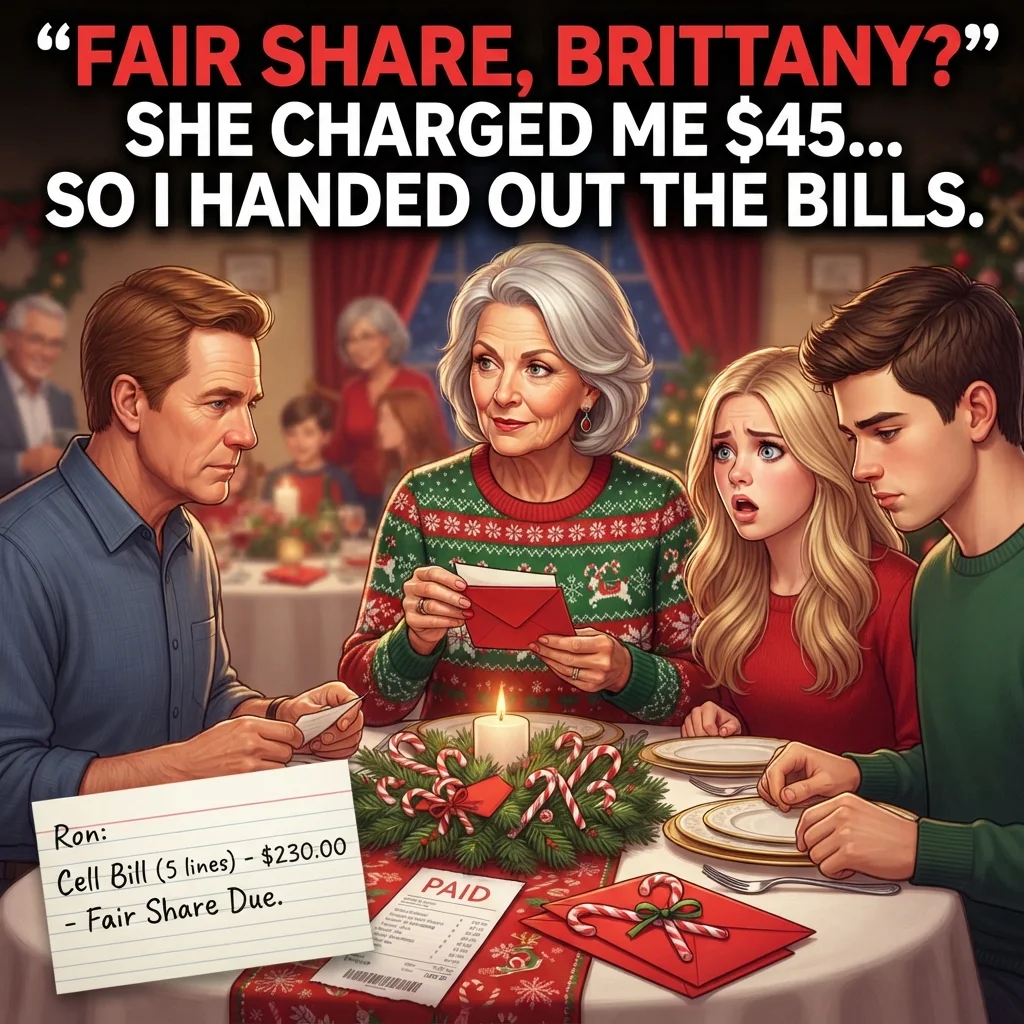
And for the first time, I wondered whether the greatest betrayal in our family had happened long before Brittany charged me forty-five dollars for Thanksgiving dinner.
TO BE CONTINUED IN PART 7 — THE PHOTOGRAPH THAT SHOULD NEVER HAVE EXISTED
You may also like

PART >> 6 My Husband Threw Me Out While I Was in Labor—Then a Three-Star General Saluted Me and Revealed Who I Really Was.
Chapter 14: The Woman Who Had Been Lying to Herself…
PART 6 — THE LAWYER WHO KNEW MY FATHER’S DEADLIEST SECRET
“There’s a reason your father chose me.” Lawrence Brennan’s words…