I thought my mother had finally lost her mind three months before my wedding.
She called me into her bedroom after dinner and closed the door behind me.
Not pushed it mostly shut.
Image
Closed it.
Then she turned the little brass lock like we were teenagers whispering about something forbidden instead of two grown women standing in her quiet house.
The room smelled like lavender hand cream and cold coffee.
A delivery truck rumbled past the curb outside, making the window glass tremble for half a second.
My mother waited until the sound faded.
Then she said, “Sophia, next week you are going to put your apartment in my name.”
I stared at her because there are some sentences so strange your brain refuses to receive them the first time.
“What?”
“You heard me.”
“My apartment?”
“Yes.”
I almost laughed, but her face stopped me.
My mother was not joking.
She was standing there in the soft yellow light by her dresser, holding the sleeve of her cardigan between two fingers, looking at me like she had already argued with herself for hours before saying it out loud.
That apartment was not a casual gift.
It was not a pretty address I had stumbled into because life had been easy.
It was a deed wrapped around years of work.
I had stayed late at the office until the cleaning crew knew my coffee order.
I had taken bonuses and moved them straight into savings instead of vacations.
I had eaten desk salads while friends sent beach photos from Florida and Mexico.
And when I finally found the place on the Upper East Side, my parents helped me close the last gap because they said they wanted me safe, settled, and independent.
It had a park view, a private elevator, a doorman who knew every regular visitor, and security so tight that even food delivery drivers looked nervous at the front desk.
It was worth over two million dollars.
It was also where Jason and I were supposed to begin our marriage.
In my mind, that apartment was already full of ordinary things that had not happened yet.
Coffee on the counter.
Sunday mornings in old T-shirts.
A stroller folded by the hallway closet someday.
A baby running down the polished floor in socks while Jason laughed and told me to slow down before I cried from happiness.
So when my mother told me to transfer it out of my name, all I heard was betrayal.
“Mom,” I said, “do you understand what you are asking me?”
“I do.”
“You want me to start my marriage hiding something from my husband.”
She did not look away.
“I want you to start your marriage with something protected.”
Those are very different sentences when you are twenty-nine and in love.
I did not know that yet.
I only knew Jason.
Jason was attentive in the way that calms everyone around him.
He opened doors for my mother.
He carried grocery bags from the car before anybody asked.
He sent flowers on normal Wednesdays and left notes on my kitchen counter when he had to leave early.
He knew how I took coffee.
He knew which elevators in my building made me anxious.
He knew exactly when to soften his voice.
His mother, Eleanor, was different.
But I kept explaining her away.
She was intense, I told myself.
She was opinionated.
She loved her only son too much.
She had corrected the florist twice, criticized my dress neckline, suggested a different cake flavor, and asked whether my nail polish was “too pale for photography.”
She had also asked, more than once, how many square feet my apartment had.
I thought that was Eleanor being Eleanor.
I thought she liked status and buildings and the little social theater of saying her daughter-in-law lived somewhere impressive.
My mother thought something else.
“Don’t tell Jason,” she said.
That was when my anger sharpened.
“You want me to lie to him.”
“No,” she said. “I want you to wait.”
“For what?”
“For people to show you what they planned before you helped them do it.”
I remember looking at her hands.
They were cold.
Too cold.
She reached for me, and I pulled back.
“Sometimes a woman doesn’t lose her home because she’s foolish,” she said. “She loses it because she believes people who already decided what they deserve from her.”
I hated that sentence.
Not because it was cruel.
Because part of me knew she had not made it up.
The following Tuesday, at 10:18 a.m., I sat beside my mother in a Midtown attorney’s office while a paralegal slid documents across a polished conference table.
The deed transfer packet had a blue clip on the top corner.
The notary stamp was still damp when I signed.
My mother watched every page like a woman watching medicine enter an IV line.
Slow.
Necessary.
Painful.
When it was done, the attorney handed her the certified copy and explained the recording process.
My mother tucked it into her purse with the kind of care people usually reserve for passports or cash.
“There,” she said once we were back in the elevator. “Now you can get married.”
I wanted to scream at her.
Instead I stared at the glowing floor numbers and felt like I had betrayed Jason before I had even taken his name.
I almost told him that night.
He came over with takeout, loosened his tie in my kitchen, and asked why I looked tired.
I said wedding stress.
He kissed my forehead and told me everything would be perfect.
For one second, I nearly confessed everything.
Then my phone buzzed.
It was my mother.
Just one text.
Wait.
So I waited.
The wedding came faster than I expected.
That is how big events always arrive.
You spend months planning them, then suddenly you are standing in a white dress while someone fixes your veil and your father is blinking too much because he does not want you to see him cry.
Our venue was in Tribeca, polished and expensive, with a high ceiling, white flowers, and a line of black SUVs outside.
There was a small American flag near the front entrance, tucked beside the brass doorframe where guests posed for photos without noticing it.
The day smelled like roses, hairspray, champagne, and floor wax.
My cousins arrived loud.
My aunts arrived glittering.
My father’s business friends arrived in dark suits and careful smiles.
Jason’s friends arrived with their phones already up.
Two hundred guests filled the room by the time I walked in on my father’s arm.
I was happy.
That part matters.
I was not walking toward doom with some secret instinct screaming inside me.
I was happy in the ordinary, foolish, beautiful way brides are allowed to be happy.
Jason cried when he saw me.
At least, I believed he did.
His eyes shone.
His mouth trembled.
He reached for my hands like he could not wait one more second.
We said our vows.
People clapped.
My mother smiled through the ceremony, but her eyes kept moving.
I noticed only once.
She looked past me toward Eleanor.
Eleanor was seated straight-backed in a gold dress, proud and polished, watching her son like the wedding was partly a coronation.
At the reception, everything looked perfect.
That is the danger of perfect rooms.
They make ugly intentions feel better dressed.
By 8:42 p.m., the band had softened, the cake was waiting, and Jason’s hand rested on my waist while photographers circled us.
The knife felt cold through my fingers.
The frosting had tiny pearl details along the edges.
I remember those details because my body grabbed onto anything small once the room began to change.
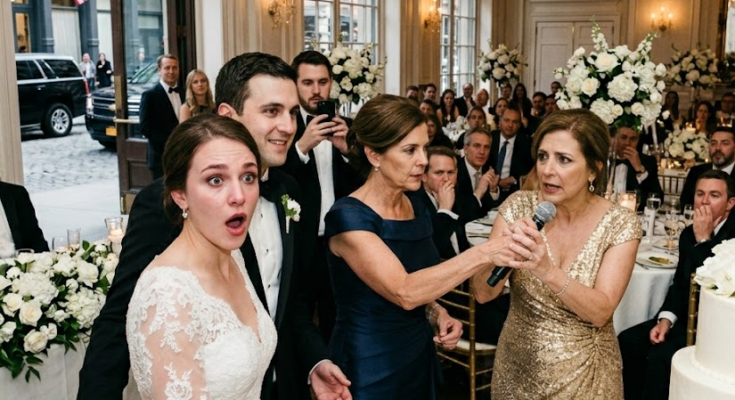
Then Eleanor asked for the microphone.
She did it with that smile of hers.
Not warm.
Not nervous.
Performed.
“I’d like to say a few words,” she announced.
People clapped.
I clapped too.
I have forgiven myself for that, but it took a while.
Eleanor walked to the center of the room in her gold dress, lifted the microphone, and looked around like she had been waiting all night for the lights to belong to her.
“Today I don’t just gain a daughter-in-law,” she said. “I gain a daughter.”
The guests made a soft sound.
That wedding sound.
The little collective sigh people give when they want the moment to be tender.
Eleanor placed a hand on her chest.
“And since we are family now, I want to thank Sophia for the generous gesture she is making for me.”
Jason’s hand tightened on my waist.
That was my first real warning.
Not Eleanor’s words.
Jason’s body.
He did not turn to me in confusion.
He did not laugh nervously.
He did not whisper, What is she talking about?
He already knew.
Eleanor smiled toward the room.
“My daughter-in-law has a beautiful apartment on the Upper East Side,” she said. “Spacious, elegant, private. Perfect for a woman my age.”
The room got quieter.
I felt the cake knife go heavy in my hand.
“And she understands,” Eleanor continued, “that when I no longer want to live alone, that lovely place will become my retirement home.”
Silence dropped over the ballroom.
Not a clean silence.
A dirty one.
Forks stopped halfway to mouths.
Champagne glasses hung in the air.
The photographer lowered his camera slowly, like even the machine in his hands understood something had gone wrong.
A piece of frosting slid down the side of the cake and nobody moved to fix it.
At Jason’s table, one of his cousins stared at the flowers instead of me.
Nobody wanted to be the first person to admit they had heard a bride get publicly stripped for parts.
I said, “What?”
It came out so quiet that I barely heard myself.
Jason rubbed my back.
That was worse than if he had grabbed me.
It was gentle.
Patronizing.
The kind of touch people use when they want witnesses to think you are unstable before you have even reacted.
“Honey,” he whispered, smiling for the cameras, “we’ll talk about it later.”
The sentence landed harder than Eleanor’s announcement.
Because that was not surprise.
That was management.
I turned my head.
“Did you know about this?” I asked him.
He did not answer.
Eleanor kept talking because nobody had stopped her yet.
“Of course, while the two of you get settled, you can stay with me for a few months,” she said. “My house is not as modern, but marriage is a lesson in humility.”
Someone laughed once.
A small, nervous sound.
Then it died.
My face burned under the makeup.
My dress felt too tight around my ribs.
For one ugly heartbeat, I imagined throwing the knife down, taking the microphone, and asking all two hundred guests whether they had come to celebrate a marriage or witness a property grab.
I did not move.
My mother did.
She rose from her chair without rushing.
Her napkin slid from her lap to the floor.
My father half-stood, but she gave him one small look and he stayed where he was.
I knew that look.
It meant she had this.
Jason’s fingers dug into my waist.
“Don’t make a scene, Sophia,” he said through his teeth.
I looked at him.
His smile was still pasted on.
His eyes were cold.
It is a strange thing to see the person you love turn into someone doing math.
Not feeling.
Not apologizing.
Calculating.
Eleanor raised her glass.
“To the newlyweds,” she said, “to family, and to that beautiful home that will very soon bring us all together.”
My mother reached us.
She did not shout.
She did not cry.
She simply took the microphone from Eleanor’s hand.
The whole room watched Eleanor’s fingers open because refusing would have made her look exactly as greedy as she was.
My mother held the microphone close.
“What a shame, Eleanor,” she said.
Her voice was calm enough to frighten me.
“That apartment doesn’t belong to Sophia anymore.”
Jason let go of my waist.
Immediately.
Not slowly.
Not gently.
Like the thing he had been holding had become hot.
Eleanor blinked.
“Excuse me?”
My mother reached into her purse and removed the certified deed packet.
The blue clip was still attached.
The county recording receipt was folded against the back page.
She laid it beside the wedding cake, next to the knife I had almost forgotten I was holding.
The room leaned without moving.
Jason whispered, “Sophia.”
I heard the warning in his voice before I heard my name.
My mother looked at him then.
Not with hatred.
With confirmation.
As if he had finally stepped into the exact spot she expected him to stand.
“She signed it three months ago,” my mother said. “Properly. Voluntarily. Recorded.”
Eleanor’s face changed color.
“You transferred your home to your mother?” she said to me, but she was not asking.
She was accusing me of stealing something she had never owned.
That was the first moment the room understood.
People began turning toward Jason.
His best man lowered his phone.
One of Eleanor’s friends put a hand to her throat.
My father stood up.
He placed a second envelope on the cake table.
This one was thicker.
Cream-colored.
Jason’s full name was written across the front in my mother’s neat handwriting.
Jason went pale.
Not embarrassed.
Pale.
There is a difference.
Embarrassment looks hot.
Fear looks bloodless.
“Don’t,” he said.
I had not touched the envelope.
I had not said anything.
Still, he was begging me.
My mother turned to me.
“Ask your husband why his mother knew about the apartment before the wedding,” she said.
My mouth was dry.
The photographer’s flash went off once by accident, a burst of white light over the cake, the deed packet, Eleanor’s empty hand, and Jason’s frozen face.
I looked at the envelope.
Then I looked at the man I had married two hours earlier.
“Jason,” I said, “what is in that envelope?”
He did not answer.
Eleanor did.
“Sophia, this is humiliating and unnecessary.”
I almost laughed.
Humiliation, apparently, became unnecessary only once it moved in her direction.
My mother slid the envelope closer to me.
Inside were printed text messages.
Dates.
Screenshots.
A copy of an email chain.
A note from the attorney’s office confirming that before the transfer, there had been multiple inquiries about whether a spouse or in-law could claim occupancy rights after marriage if the owner “moved out temporarily.”
The questions had not come from me.
They had not come from my mother.
One timestamp stood out immediately.
11:37 p.m., six weeks before the wedding.
Eleanor had written to Jason, The apartment is wasted on newlyweds. She can adjust. Once she is family, she will understand obligation.
Jason’s reply was shorter.
I’m working on her.
I read that line twice.
Not because I did not understand it.
Because I did.
I’m working on her.
Not talking to her.
Not planning with her.
Working on her.
Like I was a lock.
Like love was pressure applied until the mechanism gave.
The room had become a courtroom without a judge.
Everyone was looking at evidence.
No one knew where to put their hands.
Jason finally spoke.
“You weren’t supposed to see that.”
The sentence told on him more completely than any apology could have.
My father’s jaw tightened.
My mother closed her eyes for one second, not in surprise, but in grief.
Eleanor grabbed the edge of the cake table.
“This is family business,” she snapped.
“No,” my mother said. “This is my daughter’s life.”
Jason turned toward me then, trying to find the version of his face that had always worked before.
Soft eyes.
Lowered voice.
A hand reaching out.
“Sophia, please,” he said. “This got out of hand.”
It is amazing how small betrayal becomes when the betrayer is asked to describe it.
Out of hand.
A misunderstanding.
A conversation for later.
Anything except the plain thing.
A plan.
I looked down at the deed packet.
I thought about that attorney’s office at 10:18 a.m.
The damp notary stamp.
My mother’s cold fingers.
Her warning that I had hated because I thought it insulted the man I loved.
Then I looked at Eleanor.
She was still holding her glass.
Still dressed in gold.
Still trying to stand like a woman who had power.
But her eyes had moved to the documents.
People who feel innocent do not stare at paper that way.
I set the cake knife down.
The sound was small, but it carried.
Metal against porcelain.
Jason flinched.
“Sophia,” he said again.
I finally answered him.
“No.”
One word.
Not loud.
But it changed the temperature around us.
I took off the hand he had tried to place on my arm.
Then I turned to the guests.
“I’m sorry you all had to hear this during a wedding reception,” I said.
My voice shook, but it did not break.
“I’m even sorrier I didn’t hear it before the ceremony.”
No one moved.
My mother stood beside me with the microphone lowered.
My father picked up the envelope and placed it back on the table, perfectly aligned with the deed packet.
That was my father’s way of being furious.
Order.
Precision.
A refusal to let chaos touch the evidence.
Jason said, “You’re not seriously doing this here.”
I looked at him.
“You started it here.”
Eleanor made a sound like she had been slapped without anyone touching her.
I did not scream.
I did not throw flowers.
I did not collapse into the cake or make a scene dramatic enough for people to gossip about my emotions instead of his conduct.
I walked away from the cake table with my mother on one side and my father on the other.
The ballroom parted for us.
That was when I understood something I should have known earlier.
Silence can protect cruelty, but it can also record it.
Two hundred people had heard Eleanor announce my home as her retirement plan.
Two hundred people had watched Jason try to manage my reaction instead of defend me.
Two hundred people had seen my mother put proof on the table.
By the next morning, my phone was full.
Not just gossip.
Messages.
Apologies.
Videos.
People sent me clips from different angles because Jason’s friends had recorded everything for Instagram before they realized the wedding had become evidence.
One clip caught Eleanor’s full speech.
Another caught Jason whispering, “Don’t make a scene.”
A third showed his face when my mother said the apartment no longer belonged to me.
That one was the clearest.
You could see the plan leaving his body.
I did not go back to the apartment with him.
I went to my parents’ house.
My dress hung over a chair in the guest room like a white flag nobody had agreed to raise.
My mother brought me toast I did not eat.
My father made coffee and placed the mug near me without asking questions.
Care, in my family, had always been practical.
A document signed.
A ride offered.
A cup placed where your hand could reach it.
At 9:05 a.m., my mother called the attorney.
By 11:20 a.m., I had an appointment.
Not for revenge.
For clarity.
There were marriage documents to review, financial accounts to freeze where appropriate, and records to preserve.
The attorney told me to save everything.
So I did.
Videos.
Messages.
Screenshots.
The email inquiry.
The deed transfer.
The receipt.
The guest clips.
I cataloged them in a folder and named it WEDDING RECORDS because giving a nightmare a boring label made it easier to survive.
Jason called twelve times.
Then he texted.
Then Eleanor texted from a different number.
Her first message was not an apology.
It said, You have embarrassed this family.
That was almost funny.
Almost.
Jason’s first real message came at 1:43 p.m.
Can we talk without your mother?
I looked at it for a long time.
Then I typed back, No.
The word looked calm on the screen.
I did not feel calm.
My hands were shaking so badly the phone clicked against the coffee mug.
But the answer was still no.
In the days that followed, people tried to tell me many things.
Some said annulment.
Some said divorce.
Some said counseling.
Some said all families are complicated.
That last one made my mother laugh without humor.
“Complicated is forgetting someone’s birthday,” she said. “Complicated is not planning to move your mother into your wife’s home before the cake is cut.”
She was right.
Jason eventually came to my parents’ house.
My father did not let him past the front porch.
There was a small American flag by the mailbox, moving gently in the afternoon air, and for some reason I remember watching it instead of Jason’s face when he started talking.
He said he had panicked.
He said Eleanor pressured him.
He said he thought I would understand once we were married.
He said his mother had been lonely.
He said I was making him look like a monster.
That was the closest he came to the truth.
He was not upset because he hurt me.
He was upset because people had seen him do it.
I asked him one question.
“If my mother hadn’t transferred the apartment, what would have happened after the wedding?”
He looked away.
That was the answer.
Eleanor called my mother later that week.
I only heard my mother’s side.
“No,” she said.
Then silence.
“No, Eleanor.”
More silence.
Then my mother’s voice turned flat.
“You announced a two-million-dollar home as your retirement plan in front of two hundred people. Do not use the word misunderstanding with me.”
She hung up first.
I had never loved her more.
The legal part took longer than the emotional part wanted it to.
Legal processes do not care that your chest hurts.
They ask for dates.
They ask for signatures.
They ask for copies.
They ask whether you have saved the original messages.
So I learned to answer like a woman building a wall.
Yes.
Here.
Attached.
Recorded.
Documented.
The marriage did not become the life I pictured in that apartment.
There were no quiet breakfasts with Jason.
No Sunday pajamas.
No baby racing down that hallway while he laughed.
For a while, that grief embarrassed me.
I thought I should be grateful only.
Grateful my mother saw it.
Grateful the property was protected.
Grateful the truth came out before years had been spent trying to turn warnings into love.
But grief and gratitude can sit at the same table.
One does not cancel the other.
Months later, when I finally walked back into the apartment alone, the rooms looked exactly the same and completely different.
The park view was still there.
The elevator still opened quietly.
The kitchen still caught morning light.
But I was not the woman who had once imagined that love meant handing people access and hoping they would be gentle with it.
I stood in the hallway and thought about my mother’s sentence.
Sometimes a woman does not lose her home because she is foolish.
Sometimes she keeps it because another woman loved her loudly enough to be misunderstood.
That is what my mother had done.
She let me think she was paranoid.
She let me think she was interfering.
She let me sit in that attorney’s office angry and embarrassed because she knew my anger would heal faster than losing everything would.
Trust is rarely one big mistake.
Most of the time, it is a series of small permissions.
But protection can be that way too.
One closed bedroom door.
One cold hand.
One damp notary stamp.
One certified copy folded into a purse.
One mother standing up in a ballroom when everyone else was waiting to see whether the bride would swallow her humiliation quietly.
I used to think my wedding ended when Eleanor took that microphone.
Now I think it ended when my mother took it back.
And for the first time since that night, the apartment finally felt like what it had always been meant to be.
Not a retirement home.
Not a bargaining chip.
Not a prize for a family that mistook my trust for weakness.